Vertex Form
Linear or non-linear
In grade 9 you learned about linear relations which are relations that give you a straight line when graphed. In order to determine whether you are looking at a linear or quadratic relation you have to find first and second differences.
If your first difference is constant this tells you that you have a linear relationship. If your second difference is constant you have a Quadratic relationship.

The chart above is a quadratic relation because the second difference is all 2's (constant).
What is a parabola?

When you graph a quadratic function you get a parabola. A parabola is always 'U' shaped. They have a vertex and open up or down. Parabola's could have 1,2 or no x-inertcepts but they will always have a single y-intercept. They also have a axis of symmetry.
Parabola's are used all over the place in our real world. For example, bridges, towers, roller coasters, the Mcdonalds 'M' etc.

Analyzing parts of a parabola
Vertex: The vertex of a parabola is the highest or lowest point, also known as the maximum or minimum of the parabola. It is also the point where the parabola crosses its axis of symmetry.

Axis of symmetry: The axis of symmetry is a vertical line that divides the parabola into half. The two sides of the graph look like a mirror image of eachother. The axis of symmetry always passes through the vertex. You can find the axis of symmetry by finding the average of the x intercepts.
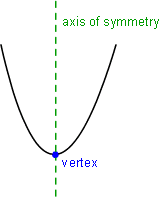
Optimal value: The optimal value is the maximum or minimum point of the parabola. It runs through the y-intercept. you can find the optimal value by subbing the axis of symmetry value into the equation (sub x to find y).

The axis of symmetry give you the x value, and the optimal point gives you the y value. These two points give you the vertex of the parabola (x,y)
Analyzing the vertex form equation
How do the parts of a parabola relate to the vertex form equation?
The variables in the vertex form equation represent the parts of the parabola
In order to graph a parabola using vertex form, you need to understand what each variable in the equation represents. The equation for vertex form is:
y = a (x-h) + k

Together the H and K value give you the vertex of the parabola. Since the H value crosses the x intercept and the K value crosses the y intercept you have your (x,y) coordinates.
The H value gives you the axis of symmetry. There is always one thing to keep in mind; the axis of symmetry is the H value with the opposite operation. For example if the H value is -5, your axis of symmetry would be x=5
Knowing whether the A value is negative or positive is very important. In this case the A value is positive; this will tell you that the parabola is facing upwards. However if the A value was negative that would tell you that the parabola is facing downwards.
The A value will affect the vertical stretch of the parabola.
The K value will give you the optimal value. The optimal point is also the y value of the parabola's vertex.
Tranlations
In order to determine the translations from the basic parabola to the second parabola you need to understand the variables of the vertex form equation
The negative in front of the A value indicates that there is a reflection in the y axis. The A value affects the vertical stretch. While analyzing the vertex form equation we learn that the H value goes through the x axis horizontally thus the H value affects the horizontal translation. Lastly the K value goes through the y axis vertically therefore it affects the vertical translation.

Example 1: Graph
Describe the transformation from the original grey parabola to the purple parabola.
Example 2: Equations
Describe the tranformation that occured to y=x^2 in order to become y= -3 (x-2)^2 + 5
-
reflection in the x axis (negtaive sign infront of a value)
-
verticle stretch of 3 (The a value is 3)
-
horizontal shift right 2 units (opposite of the H value)
-
verticle shift up 5 units (k value)
-
Horizontal shift left 3 units
-
Verticle shift up 2 units
X-intercepts
The x-intercept is where the parabola crosses the x axis. A parabola could have one x intercept, two or none. They are also known as solutions, roots or zeros.

Graphing and Step pattern
In order to graph a parabola you need to use a step pattern. Start off by graphing the vertex of the parabola (h,k) because the vertex decides where we start the step pattern. Then use the step pattern to get the following points of the parabola. The step pattern is:
Over 1, up 1
Over 2, up 4


2x^2
The first graph follows the normal step pattern. However the second graph is 2x^2. This has an A value of 2 therefore the stretch value will be different. When you have an A value you are required to multiply the numbers you’re suppose to go up by on the graph, with the A value.
For eample this graph goes over 1, up 2 (1x2=2)
over 2, up 8 (4x2=8)
Solving in Vertex Form
Without knowing the parts of a parabola and understanding the parts of the vertex form quation, you wouldnt be able to graph a parabola.
When you are solving, you are looking for the x intercepts or the zeros. I know you can find the x intercepts by graphing the parabola, however that is not always the fastest mathod. There is also another very simple concept with just a few basic steps:
Step 1: Sub in y=0 into the equation to solve for x.
Step 2: Now you have to move everything to the other side to get x alone.
Step 3: Keep in mind SAMDEB (subtraction, addition, multiplication, division, exponents, and brackets). This is the order you have to follow.
Step 4: Start off by moving the K value to the other side because the k value is either being added or subtracted, and that is your first step in SAMDEB. Keep in mind that the operation changed when it goes to the other side. For example 0= -4 (x-7)^2 +36 would be -36= -4 (x-7)^2
Step 5: Move the A value over to the other side because it is being multiplied and multiplication is the next step in SAMDEB. Once you bring the A value over it is being divided because the operation becomes the opposite.
Step 6: After multiplication is exponent (SAMDEB). The opposite of exponents is square rooting. So square root both sides to get rid of the exponent 2.
Step 7: After square rooting you will receive two answers; a negative answer and a positive answer.
This video will take you step by step through the processs and help you better understand the concept.
How does Vertex Form connect to graphing?
The vertex form gives you the vertex. Therefore the vertex can be easily plotted on the graph and then you can simply use step pattern to plot the next points.