Standard Form
The third quadratic equation that can be represented for a parabola is standard form. In order to graph a parabola using standard form you need to understand what each variable represents. The equation for standard form is written as y=ax^2+bx+c
Axis of symmetry and optimal value
Earlier we learned how to find the axis of symmetry and the optimal value. However, when working with a standard form equation there is a short cut to finding these two things:
Axis of symmetry
If you wanted to find the vertex of the equation or graph it while it's in standard form you can use the formula (-b/2a) to find the axis of symmetry. This will give you the x value of the vertex.
Optimal value
In order to find the rest of the vertex you have to find the optimal value (y value of vertex). You can find the optimal value by plugging in the value of the axis of symmetry into the original equation.
Completing the Square
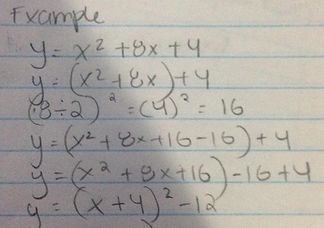
Completing the square is a method used to convert standard form into vertex form.
-
Group the x^2 and the x terms together from standard form (put them in brackets)
-
Move the common factor from the x^2 and x term to the outside of the bracket
-
Find the third (h value) that must be added and subtracted to create the perfect square. Use the formula (b/2)^2
-
Rewrite the expression by adding and subtracting that constant
-
Move the subtracted value outside the bracket by multiplying it by the common factor first
-
Now you have grouped the three terms that form the perfect square
-
Factor the perfect square and collect like terms
Quadratic Formula
The easiest way to solve for zeros when given standard form is by using the quadratic formula. We learned how to solve quadratic equations by factoring. However, this method may not always work for every equation. Thus, you can use the quadratic formula for cases that cannot be factored.

The quadratic formula is:
-
Set the value of y to 0 by placing all values onto one side of the equal sign
-
Plug in your a, b and c values into the formula
-
Solve for the roots
-
Express answers as exact roots and approximate roots
Example 1 Example 2


Watch this video for more help with the quadratic formula
Discriminate
The number inside the square root of the quadratic formula is called the discriminate (D). It helps us tell how many solutions a quadratic equation has:
-
If the discriminate is less than zero (a negative number) you don’t have any solutions because a negative number cannot be square rooted
-
If discriminate is greater than zero you receive two distinct solutions
-
When discriminate equals zero, this means you have only one solution
Types of Factoring
Common Factoring Factoring by Grouping
Factoring Simple Trinomials Factoring Complex Trinomials
Difference of Squares Perfects Sqaures
How does Standard Form connect to graphing?
In order to graph using standard form, you have to complete the square, use the quadratic formula or use the axis of symmetry & optimal value shortcut to determine the certain points on the parabola.